Few objects in science are as famous — or as misunderstood — as black holes. They appear in films as cosmic drains swallowing everything nearby. The reality is stranger, and in some ways calmer.
What is a black hole?
A black hole is a region of space where matter is packed so densely that gravity becomes overwhelming. To escape any object you need to travel faster than its escape velocity. For Earth that is about 11 kilometres per second. For a black hole, the escape velocity exceeds the speed of light — and since nothing travels faster than light, nothing that crosses a certain boundary can get out.
The event horizon
That boundary is called the event horizon. It is not a physical surface you could touch; it is a point of no return. Outside it, light and matter can still escape. Inside it, every possible path leads further in.
The size of the event horizon depends on the mass. A black hole with the mass of our Sun would have an event horizon only about 3 kilometres in radius.
How black holes form
Astronomers know of black holes across a huge range of sizes, formed in different ways:
- Stellar-mass black holes form when a very massive star runs out of fuel and its core collapses under its own gravity, often in a supernova explosion.
- Supermassive black holes, millions to billions of times the mass of the Sun, sit at the centres of most large galaxies. How they grew so large so early in cosmic history is an active research question.
- Intermediate-mass black holes fall in between and are much harder to find; only a handful of candidates are known.
The black hole at the heart of our galaxy
At the centre of the Milky Way lies a compact object called Sagittarius A*. By tracking stars orbiting it over decades, astronomers showed that it must have a mass of about four million Suns packed into a region too small to be anything but a supermassive black hole.
That work was recognised with the 2020 Nobel Prize in Physics, shared by Reinhard Genzel and Andrea Ghez, while Roger Penrose was honoured for showing that black hole formation is a robust prediction of general relativity.
Seeing the invisible
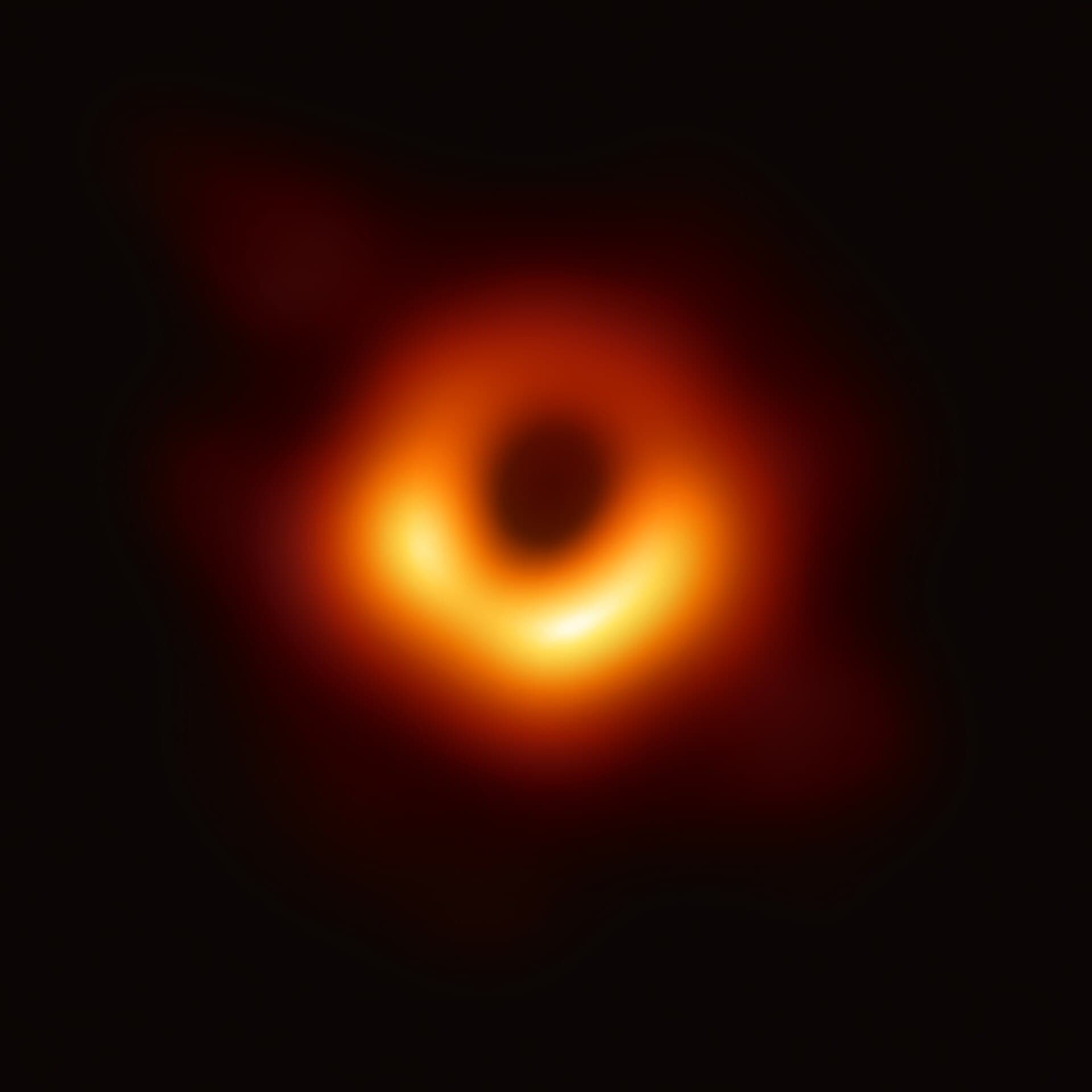
A black hole emits no light of its own, but the gas swirling around it can glow brightly. In 2019 the Event Horizon Telescope — a network of radio observatories across the globe working as one Earth-sized telescope — released the first image of a black hole's shadow, in the galaxy Messier 87. In 2022 it followed with an image of Sagittarius A*.
The image shows not the black hole itself but its shadow: a dark region outlined by light bent around it.
What happens if you fall in?
Near a stellar-mass black hole, the difference in gravitational pull between your head and your feet would be enormous, stretching you out — a process physicists half-jokingly call spaghettification. Near a supermassive black hole these tidal forces are much gentler at the horizon, so you could in principle cross it without noticing anything special at that moment.
Time slows down
General relativity predicts that time passes more slowly in stronger gravity. To a distant observer, an object falling towards the horizon appears to slow down and fade, never quite seeming to cross it.
Do black holes last forever?
In 1974 Stephen Hawking showed that, once quantum effects are included, black holes should slowly emit radiation and lose mass. This Hawking radiation is far too faint to detect from black holes formed by stars, which would take vastly longer than the current age of the universe to evaporate. It remains one of the most important unconfirmed predictions in physics.
- Escape velocity beyond the event horizon exceeds the speed of light.
- Stellar black holes form from collapsing massive stars; supermassive ones anchor galaxies.
- Hawking radiation suggests black holes slowly evaporate — in theory.